
Organizations that run leadership competency assessments tend to end up with the same messy setup: a survey tool to collect responses, a billing system to charge for the service, and a pile of spreadsheets to turn responses into something a manager can act on. A dedicated leadership assessment platform replaces that patchwork with one system that creates, distributes, analyzes and monetizes assessments. This post covers how we built the backend for one with Node.js, TypeScript, MongoDB and Stripe.
The worked example is our Leadership Assessment Platform project, an enterprise backend API that powers competency assessments for organizations. We will cover the data model, bulk CSV workflows, Stripe subscription billing, real-time notifications and the security work that enterprise buyers expect.
What leadership assessment software needs to handle
The requirements break down into four groups:
- Assessment management: create assessments, import and export them in bulk, and distribute them to the right people.
- Organizations and users: group users by organization, share assessments within those groups, and support multiple roles (Admin and Customer).
- Monetization: charge for the service through subscriptions without manual invoicing.
- Insight: analytics and competency comparison reports that turn raw responses into something useful.
The challenge was doing all of that in one system rather than stitching together separate survey, billing and reporting tools. Every integration seam between tools is a place where data gets copied, goes stale, or leaks.
Why Node.js, TypeScript and MongoDB for an assessment API
The platform is an API-first backend built on Node.js, TypeScript and Express.js. That choice was driven by the shape of the work. An assessment API is mostly I/O: reading and writing responses, calling Stripe, uploading files to AWS S3, sending email through Nodemailer, and pushing real-time events. Node.js handles that kind of concurrent I/O well, and TypeScript keeps a large API surface maintainable as it grows.
MongoDB fits the data. Leadership assessments vary in structure: different competency frameworks, different question sets, different scoring. A document model lets each assessment carry its own structure without a migration every time a client wants a new format. The trade-off is that you need to be disciplined about validation at the API layer, since the database will not enforce a schema for you.
Building API-first also means the backend can serve a web dashboard today and other clients later. The platform includes comprehensive API documentation, which is what makes that practical. We cover this approach in more depth on our Node.js development page.
How to build bulk CSV import and export for assessments
Enterprise customers rarely want to type assessments into a form one question at a time. They already have competency frameworks and participant lists in spreadsheets. Bulk CSV import and export was therefore a core feature, not a nice-to-have.
A reliable CSV pipeline follows a few rules:
- Validate before you write. Parse the whole file, check every row, and return a clear list of errors with row numbers before anything touches the database.
- Make imports idempotent where possible. Re-uploading a corrected file should not create duplicates.
- Store the original file. The platform uses AWS S3 with presigned URLs for file storage, so uploads go directly from the client to S3 and the API never streams large files through itself.
- Make export the mirror of import. If a customer can export, edit and re-import, they will trust the system with their real data.
Presigned URLs are worth calling out. They let the browser upload straight to S3 with a short-lived, scoped permission, which keeps the API fast and avoids holding large files in server memory.
Adding Stripe subscription billing with webhooks
The platform monetizes assessments through an integrated Stripe subscription system. The key to doing this properly is webhook handling. A checkout succeeding in the browser is not proof of payment; Stripe's webhook events are the source of truth for subscription state.
The standard pattern we follow:
- Create subscriptions through Stripe and store the Stripe customer and subscription IDs against the organization or user.
- Verify every webhook signature before processing it.
- Handle events idempotently, because Stripe can deliver the same event more than once.
- Drive access from the stored subscription state, updated by webhooks, rather than from what the client reports.
Stripe's subscription webhooks documentation covers the event types in detail. For a wider comparison of payment options, see our payment gateway integration guide.
Real-time notifications with Socket.io
Assessments are a workflow: one is assigned, participants complete it, results become available. People want to know when something changes without refreshing a page. The platform uses Socket.io for real-time notifications, and Nodemailer for email where a message needs to reach someone who is not currently online.
A clean way to structure this is to emit notifications from the same service code that changes state. When an assessment is shared with an organization, or a result is ready, the service records the change and then emits an event to the relevant users' sockets. Authenticating socket connections with the same JWT used by the REST API keeps access rules consistent across both channels.
Analytics and competency comparison reports
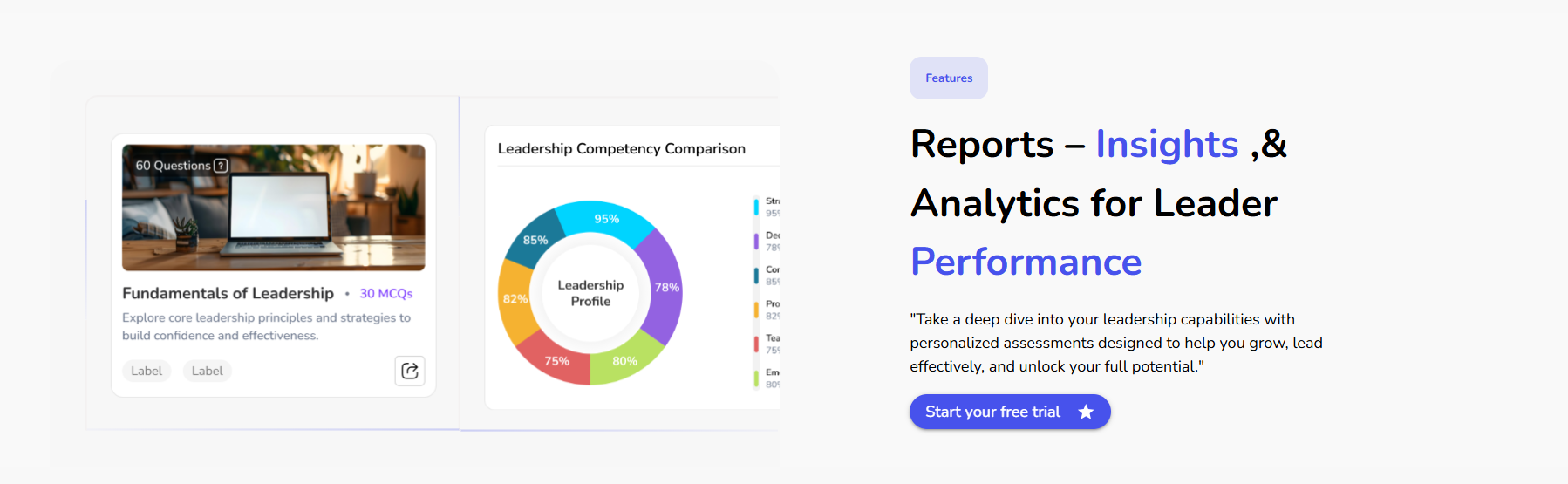
Collecting responses is the easy part. The value of leadership assessment software is in what it tells you afterwards. The platform includes advanced analytics and competency comparison reports, which let organizations compare competency results and spot where development is needed.
In MongoDB, this kind of reporting is typically built with aggregation pipelines that group responses by competency, organization or assessment and compute scores. Two practical lessons apply to any reporting feature like this:
- Scope every query by organization. Organization-based grouping is a security boundary as much as a feature.
- Precompute what is expensive. If a report is slow to compute and viewed often, store the result and refresh it when new responses arrive.
Securing an enterprise assessment platform
Assessment data is sensitive. It describes how people are rated at work. Enterprise buyers will ask about security, and the platform was built with that in mind:
- JWT authentication with passwords hashed using Bcrypt.
- Helmet for secure HTTP headers.
- Express Rate Limit to slow down brute-force and abuse.
- XSS protection and data sanitization on incoming input.
- Multi-role access control separating Admin and Customer capabilities.
None of these are exotic. They are the baseline, and skipping any of them is how otherwise good products fail security reviews.
If you are planning something similar, our advice is to settle three things before writing code: how organizations and roles map to data access, which events change a customer's subscription state, and what your bulk import format looks like. Those decisions shape the schema, the billing logic and the API contract. Getting them wrong early means a painful migration once real customers have data in the system. Everything else, from report layouts to notification wording, is comparatively easy to change later.
You can see how they come together in the full leadership assessment platform case study.
Frequently Asked Questions
Can you build a 360 leadership assessment tool on Node.js?
Yes. Node.js with Express and TypeScript is a strong fit for an assessment API, which is mostly I/O: storing responses, sending notifications, handling payments and uploading files. Multi-rater 360 workflows are a data-model question layered on top.
How do you charge for assessments with Stripe?
Use Stripe subscriptions and treat webhooks as the source of truth. Verify webhook signatures, handle events idempotently, and grant access based on stored subscription state rather than what the browser reports.
Why use MongoDB for assessment data?
Assessments vary in structure across competency frameworks and clients. A document database lets each assessment carry its own shape, as long as you validate input carefully at the API layer.
Should we build custom leadership assessment software or buy one?
If an existing tool fits your framework and you do not need to resell the service, buying is usually faster. Custom makes sense when you have your own methodology, need to monetize assessments, or need deep integration with your other systems.
If you are planning an assessment product, an HR tech SaaS, or a backend API that needs billing and real-time features built in, our API development and integrations team can help. Contact us and we will give you a straight answer on scope and approach.