
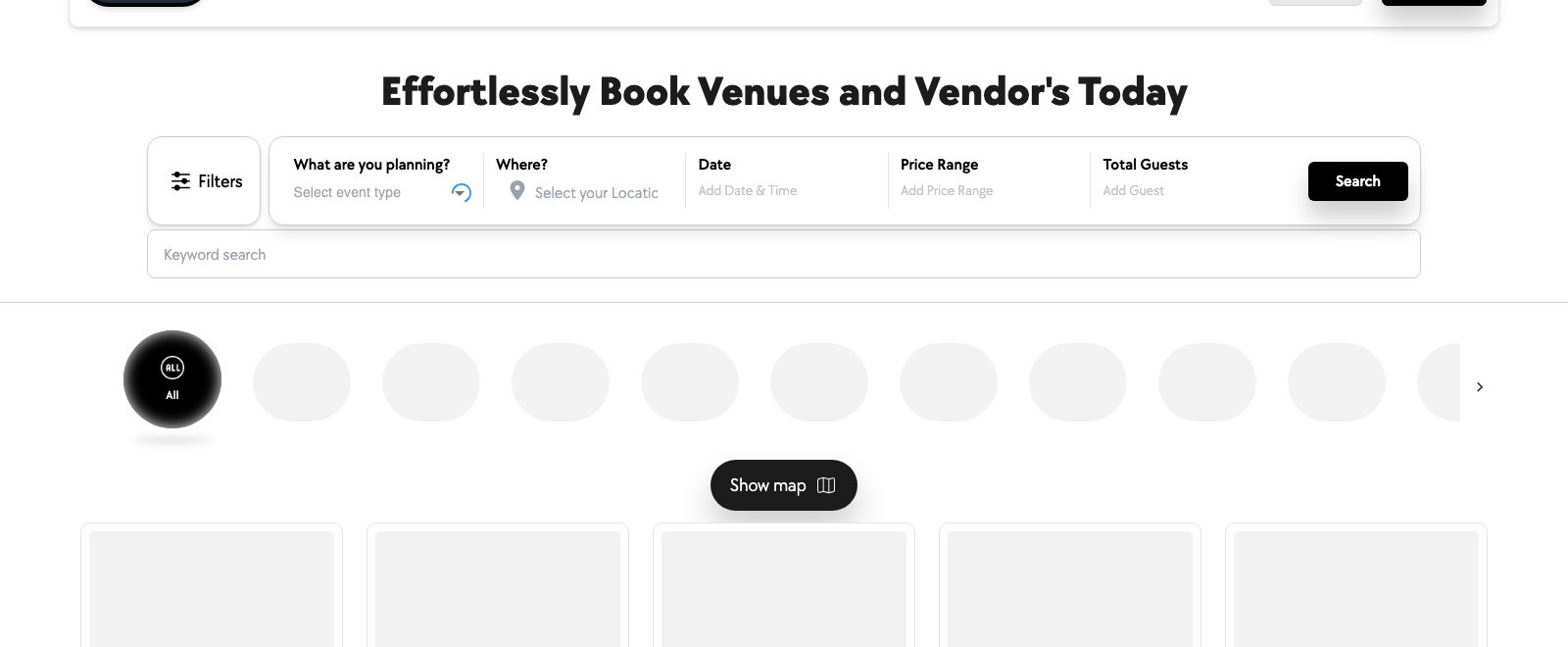
Planning an event usually means juggling a venue, a caterer, a photographer and several other suppliers, each found separately, booked by phone or message, and paid in different ways. If you are researching how to build a venue booking marketplace that brings guests, venue hosts and vendors onto one platform with real availability and secure payments, this guide uses GalaTab as a worked example of the architecture, the tricky parts and the decisions to make early.
GalaTab is a venue and vendor booking platform we built to unify the event planning experience. You can read the project summary on the GalaTab case study page.
The problem an event booking marketplace has to solve
The starting point was a familiar one. Event planners struggled to discover reliable venues and vendors, bookings were handled manually, and communication and payments lacked transparency. On the other side, hosts and vendors had no single place to manage their listings, availability and revenue.
That is a two-sided problem, really a three-sided one. GalaTab serves three user types: guests who book, hosts who list venue spaces, and vendors who list services. Each needs a different experience, and the platform only works if all three trust it. That shapes every technical decision, which is why we approached it as a product build through our SaaS product development service rather than a simple website.
The stack: React, Node.js, MongoDB, Stripe and Socket.io
GalaTab runs on a deliberately mainstream stack:
- React for a mobile-responsive web app that works across devices, so there is no separate native app to maintain at launch.
- Node.js and Express.js exposing REST APIs for listings, bookings, profiles, reviews and payments.
- MongoDB for data. Venue and vendor listings vary a lot in their attributes, so a flexible document model fits well.
- Stripe for secure payment processing.
- Socket.io for real-time chat and availability.
- JWT authentication for stateless, role-aware API access.
- Vercel for deployment.
None of this is exotic, and that is the point. Every hard problem in a marketplace, from payment webhooks to concurrent bookings, already has a well-understood solution on this stack. Our article on building a SaaS MVP that scales explains why boring technology is usually the right call.
How to model listings, availability and search
Guests on GalaTab search venues and vendor services by event type, location, date, price range and guest count, and can view an availability calendar for each listing. Getting this right depends on the data model more than the interface.
A sensible way to structure it is to separate three things:
- Listings: the venue space or vendor service, with its description, location, pricing and capacity.
- Availability: the dates and time slots a listing can be booked, owned and edited by the host or vendor.
- Bookings: the record that a guest has reserved a slot, with its status and payment state.
Keeping availability separate from listings means a host can block out dates without touching their listing, and search can filter on availability without loading every booking. Indexes on the fields people filter by, such as location, price and dates, keep search fast as the number of listings grows.
Automating the booking workflow with instant confirmation
Manual booking was one of the core pain points, so GalaTab automates the workflow with instant confirmation and scheduling. A guest picks a slot, pays, and the booking is confirmed without a back-and-forth.
The hard part of instant booking is the race condition: two guests trying to book the same slot at the same moment. The standard approach is to make the slot reservation atomic on the server, so only one request can claim it, and to hold the slot briefly while payment completes. If payment fails or times out, the slot is released. If you design this as a clear set of booking states from the start, such as pending, confirmed and cancelled, every other feature, including dashboards, notifications and refunds, becomes easier to build.
Real-time availability helps here too. GalaTab pushes availability changes over Socket.io, so a guest looking at a calendar sees a slot disappear when someone else books it, rather than finding out at checkout.
Integrating Stripe payments in a booking marketplace
Secure payment processing with transparent transaction management is central to trust on a marketplace. GalaTab uses Stripe, and a few principles apply to any Stripe integration of this kind:
- Let Stripe handle card data. Using Stripe's hosted or embedded payment components keeps card details off your servers and reduces your compliance burden.
- Treat webhooks as the source of truth. Confirm a booking when Stripe tells your server the payment succeeded, not when the browser says it did. Browsers close, networks drop, and webhooks are reliable.
- Make webhook handling idempotent. Stripe may deliver the same event more than once, so processing it twice must not create two bookings.
- Show the transaction clearly. Guests should see what they paid for, and hosts and vendors should see what they are owed.
If you are planning a marketplace that pays out to multiple sellers, look at Stripe Connect early, because how money flows between parties affects your legal and accounting setup as much as your code. Our payment gateway integration guide covers the wider options.
Real-time chat, reviews and dashboards that build trust
Marketplaces run on trust, and GalaTab builds it in three ways.
Real-time chat with Socket.io
Guests, hosts and vendors message each other directly through built-in chat powered by Socket.io. Keeping communication on the platform means questions and agreements are visible in one place instead of scattered across phone calls and personal messaging apps. Messages should be stored in the database as well as delivered live, so conversations survive page reloads and can be reviewed if there is a dispute.
Reviews and ratings
A review and rating system lets guests share their experience, which helps future guests choose and gives good hosts and vendors a way to stand out. The sensible rule is to allow reviews only from guests with a completed booking, so ratings reflect real events.
Dashboards for every user type
Hosts and vendors get dedicated dashboards for managing listings and bookings. Guests get profiles with booking history and saved favourites. JWT authentication with role information means one API can serve all three user types while each sees only what they should.
What to put in your first release
Marketplaces are tempting to over-scope. We regularly advise clients to launch with the smallest set of features that lets a real booking happen end to end: listings, search, availability, booking, payment and messaging. Reviews matter early because they build trust, but advanced features such as promotions, complex pricing rules or multi-currency support can usually wait until real usage shows they are needed. The API and integrations work behind payments and notifications deserves the most care, because mistakes there cost money and trust. Everything else can be refined once guests, hosts and vendors are actually using the platform.
Frequently Asked Questions
What tech stack is best for a venue booking marketplace?
There is no single best stack, but React, Node.js, MongoDB, Stripe and Socket.io is a proven combination. It is the stack behind GalaTab, covering the web app, APIs, flexible listing data, payments and real-time chat.
How do you prevent double bookings on an event booking platform?
Reserve the slot atomically on the server so only one request can claim it, hold it briefly during payment, and confirm the booking only when the payment webhook arrives.
Should a booking marketplace launch as a web app or a mobile app?
We usually recommend a mobile-responsive web app first, as GalaTab did. It reaches every device on day one. Native apps can follow once usage justifies them; our mobile app development cost guide covers that decision.
Can guests, hosts and vendors share one platform?
Yes. GalaTab supports all three user types on one marketplace, with role-based dashboards and profiles.
You can explore the live GalaTab app or read the full GalaTab case study. If you are planning a booking marketplace of your own, talk to us. We will help you scope what belongs in the first release and what can wait.