
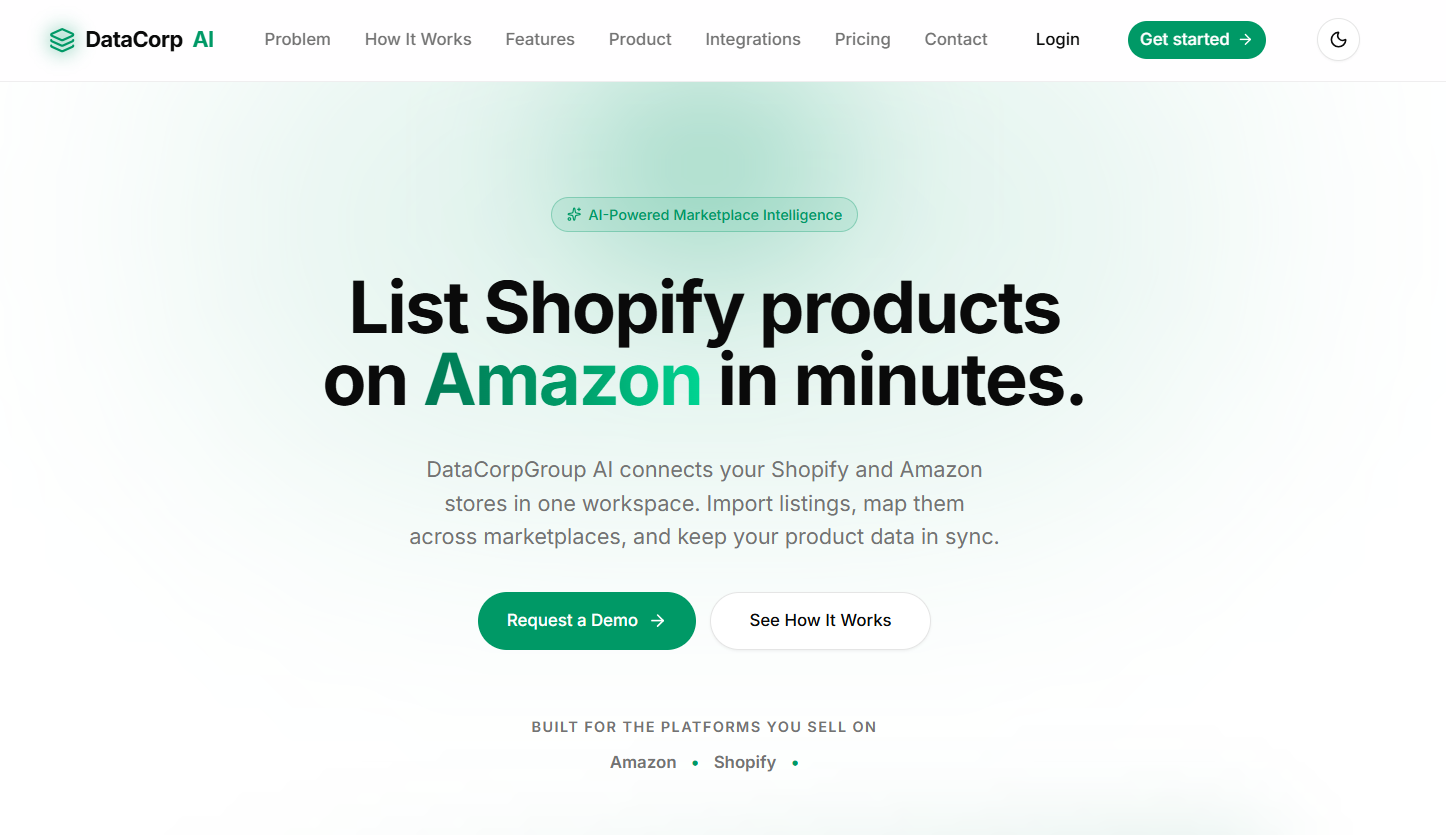
Anyone who has tried to move a Shopify catalog onto Amazon knows the problem. Shopify stores a title, a description, some options and a few metafields. Amazon files every listing under one of roughly 1,900 product types, each with its own schema of required, conditionally required and compound attributes. Doing that by hand takes 15 to 30 minutes per product, and you usually find out what was wrong only after Amazon rejects the submission. Shopify to Amazon listing automation with AI sounds like the obvious fix, but a model that confidently guesses missing values creates a worse problem than the one it solves.
This guide walks through how we built DataCorpGroup AI, a multi-tenant SaaS that turns a Shopify catalog into publish-ready Amazon listings, and the design decisions that made it trustworthy enough to actually publish.
Why Shopify to Amazon listing automation is harder than it looks
The gap between the two platforms is not a formatting problem. It is a data problem. A valid Amazon listing needs:
- The correct product type, which determines the entire schema.
- Values from closed lists, where only specific enumerated values are accepted.
- Compound fields that need a value and a unit together.
- A resolved product identity: a barcode, a GTIN exemption, or a match to an existing ASIN.
- Variations grouped under a valid variation theme.
Much of that is simply not in Shopify. The tempting shortcut is to let a language model fill in every blank. The trouble, as we put it in the project brief, is that an invented specification publishes silently while an empty field is recoverable. A wrong battery capacity or a made-up material does not fail validation. It goes live, and the seller owns the consequences.
For listing automation, an honest empty field is better than a confident wrong one. The whole architecture follows from that rule.
The architecture: Next.js, Node.js and a FastAPI AI engine
DataCorpGroup AI is a three-tier system, and the split between tiers is deliberate:
- Next.js 16 workspace with React 19, TypeScript and Tailwind CSS 4. It drives a five-stage mapping wizard: Source, Preview, AI Mapping, Validate, Publish. TanStack Query handles server state, Zustand holds local wizard state, and React Hook Form with Zod validates merchant input.
- Node.js 22 and Express backend that owns tenancy, credentials, sessions, billing and the publish gate. MongoDB with Mongoose stores the data.
- Stateless Python FastAPI AI mapping engine that the backend orchestrates over exactly three operations: map, recompute requirements, and fix errors. It uses OpenAI models for inference.
Why Python for the AI layer and Node.js for everything else? The Python ecosystem is where most of the data and LLM tooling lives, while Node.js is a strong fit for the API, real-time and integration-heavy work. Keeping the engine stateless means it can be scaled, redeployed or swapped without touching tenancy or billing. The backend talks to it with a separate service token, so the engine is never directly exposed to users.
The most important rule: the engine proposes, the backend decides. The AI service returns mappings; the Node.js backend stores the response verbatim and is the only component allowed to decide what may be published. If you take one idea from this post, take that one. We use the same separation in most of our AI integration and automation work.
How AI maps Shopify products to Amazon product types and attributes
The unit of work is a session, sometimes called a run. It is also the unit of retry, audit and billing. For each session, the backend assembles the raw Shopify products plus marketplace context, resolved identity flags and the merchant's saved defaults, then sends the bundle to the engine.
The engine then:
- Selects the product type across roughly 1,900 Amazon types, with the live schema fetched and cached.
- Maps attributes from Shopify options, metafields and catalog matches.
- Attaches a confidence score and provenance to every AI-generated value, so you can always tell what came from real source data and what the model inferred.
- Returns gap questions for anything that genuinely cannot be derived.
Those gap questions are where good UX matters. The workspace renders each one with the right control: locked dropdowns for closed lists, open comboboxes where Amazon suggests values, and value-plus-unit boxes for compound fields. That alone eliminates a whole class of rejections caused by free-text answers.
Merchant answers are then saved as defaults at six levels of specificity: store, category, product type, brand, product and variant. The next session reuses them, so each session asks fewer questions than the last. This is the feature that turns a tool people try into a tool people keep using.
Validating listings against the Amazon SP-API before you publish
Amazon publishing goes through the Selling Partner API, which has its own authentication model: Login with Amazon OAuth per seller, AWS SigV4 request signing, and STS role assumption. Refresh tokens are encrypted at rest. If you are planning SP-API work, read Amazon's Selling Partner API documentation early; the auth setup is the part teams most often underestimate.
Before anything is submitted, the backend validates the assembled payload against Amazon's live schema and applies the publish gate:
- Block on genuinely empty required fields, closed-list violations and unresolved product identity.
- Warn only on low-confidence values and AI-invented values, so the merchant can review them without being stopped.
Identity resolution is its own subsystem: GTIN exemptions scoped per brand, product type and marketplace, ASIN catalog matching, and variation-theme grouping. The platform supports 9 Amazon marketplaces across North America, Europe and the Far East, so all of this has to be marketplace-aware.
Building an error-repair loop for Amazon rejections
Even with validation, Amazon will reject some submissions. Most tools stop there and leave the seller with an error code. DataCorpGroup AI polls feed status, reads back Amazon's verdict, and feeds rejections into a repair cascade that tries, in order, to:
- Fix the value automatically.
- Re-derive it from source data.
- Hand the field back to the merchant as a question, with Amazon's rejection reason attached.
Resubmission happens without rebuilding the session. In testing, 473 of 473 listings were accepted by Amazon in about 8 minutes, and the engine auto-filled 67% of 10,722 required attributes, or 80% including optional ones. The remaining gaps are exactly the ones a human should answer.
Multi-tenant SaaS plumbing: billing, real-time and security
Listing automation is the headline, but a production SaaS needs everything around it:
- Stripe billing across five tiers, with a feature-catalog entitlement system for metered, capacity and boolean limits. Quotas hard-stop, and failed runs are refunded.
- Socket.io for real-time mapping progress, notifications and support chat, plus in-app, email and Firebase FCM push with per-event channel preferences.
- Shopify Admin API OAuth install with a local catalog mirror, incremental sync and per-product refresh.
- Auth and security: JWT, Google OAuth via Passport.js, TOTP two-factor auth, role-based rights, an audit trail, Helmet, rate limiting and input sanitization.
- An admin console for AI monitoring, mapping pattern analysis, schema config, analytics and seller management.
None of this is glamorous, but it is what lets a seller trust the system with real catalogs. For more on the integration side, see our API development and integrations service and the full DataCorpGroup AI case study.
Frequently Asked Questions
Can AI automatically create Amazon listings from Shopify products?
Partly, and that is the honest answer. AI can select the product type and fill a large share of attributes from real source data. In our testing it auto-filled 67% of required attributes. The rest should come from the merchant, because invented specifications publish silently.
Which Amazon API do you use to publish listings?
The Amazon Selling Partner API (SP-API). It needs Login with Amazon OAuth per seller, AWS SigV4 request signing and role assumption, and it reports results asynchronously through feed status you poll.
How do you stop AI from inventing product data?
Record a confidence score and provenance on every generated value, and keep the publish decision outside the AI service. In DataCorpGroup AI the backend blocks empty required fields and closed-list violations, and flags AI-invented values for review.
Does Shopify to Amazon listing automation work across marketplaces?
It can, but schemas, identity rules and GTIN exemptions vary by marketplace. DataCorpGroup AI supports 9 Amazon marketplaces across NA, EU and Far East regions, with marketplace-aware validation.
If you are building marketplace automation, or any product where AI output has to be trustworthy enough to act on, we are happy to talk through the architecture. Contact us and tell us what you are working with.