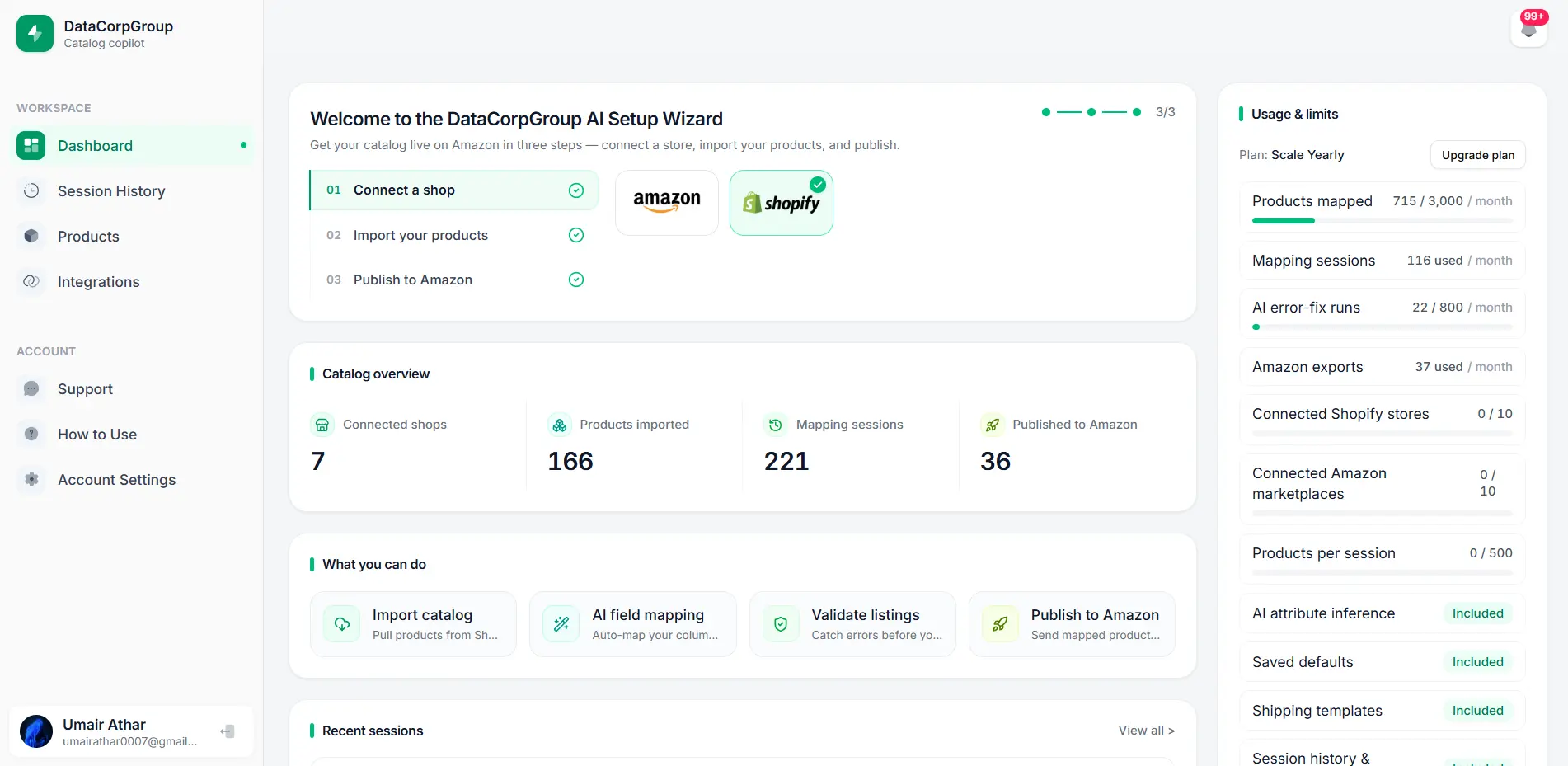
Multi-tenant AI platform that turns a Shopify catalog into publish-ready Amazon listings — product-type selection, attribute mapping, pre-submission validation, and an error-repair loop across 9 marketplaces.
Listing a Shopify catalog on Amazon is manual work measured in 15–30 minutes per product: pick the product type, learn its schema of hundreds of attributes, satisfy closed value lists and compound value-plus-unit fields, resolve barcode identity, group variations under a valid theme — then find out what was wrong only after Amazon rejects the submission. An AI that guesses to fill the blanks makes it worse, because an invented specification publishes silently while an empty field is recoverable.
We built a session-based workspace where a run is the unit of work, retry, audit and billing. The backend assembles raw Shopify products plus marketplace context, resolved identity flags and the merchant's saved defaults, sends them to the AI engine, and stores the response verbatim. Values the model invented rather than sourced are recorded with a confidence score and provenance, and the backend — never the engine — decides what may be published: genuinely empty required fields, closed-list violations and unresolved identity block; low-confidence values only warn. Merchant answers persist as saved defaults at six levels of specificity, so each session asks fewer questions than the last, and Amazon's rejections feed back into a repair cascade that fixes, re-derives, or hands the field back as a question with the rejection reason attached.
473 of 473 test listings accepted by Amazon in ~8 minutes
of 10,722 required Amazon attributes auto-filled (80% incl. optional)
Amazon marketplaces across NA, EU, and Far East regions
Amazon product types the engine selects and validates against
Five-stage mapping wizard: Source → Preview → AI Mapping → Validate → Publish
AI product-type selection across ~1,900 Amazon types, with live schema acquisition and caching
Attribute mapping from Shopify options, metafields and catalog matches, with confidence scores and provenance on every AI-generated value
Merchant gap questions rendered with the right controls — locked dropdowns for closed lists, open comboboxes for suggested values, value + unit boxes for compound fields
Saved defaults at six levels of specificity (store, category, product type, brand, product, variant) so each session asks fewer questions than the last
Backend-owned publish gate: empty required fields, closed-list violations and unresolved identity block; low-confidence and AI-invented values warn only
Amazon error-repair loop — rejections are fed back for a fix cascade and resubmitted without rebuilding the session
Product identity resolution: GTIN exemptions scoped per brand/type/marketplace, ASIN catalog matching, and variation-theme grouping
Shopify Admin API OAuth install with a local catalog mirror, incremental sync, and per-product refresh
Amazon SP-API authorization per seller with encrypted refresh tokens, SigV4 request signing, delegated role assumption, and feed status polling
Feature-catalog entitlements — metered, capacity and boolean limits enforced with quota hard-stops and refunds on failed runs across five Stripe tiers
Admin console: AI monitoring, mapping pattern analysis, schema config, platform analytics, export history, seller management and support chat
Realtime updates over Socket.io plus in-app, email and FCM push notifications with per-event channel preferences
JWT + Google OAuth + TOTP two-factor auth, role-based rights, audit trail, and a separate service token for backend↔AI-engine calls
Next.js 16, React 19, TypeScript, Tailwind CSS 4, Radix UI / shadcn, TanStack Query 5, Zustand 5, React Hook Form + Zod, Recharts, Serwist (PWA), socket.io-client, Biome, Node.js 22 (ESM), Express.js, MongoDB (Mongoose), Python FastAPI AI microservice, OpenAI, Amazon Selling Partner API (LWA OAuth + AWS SigV4 + STS role assumption), Shopify Admin API, Socket.io, Stripe, AWS S3 (presigned URLs), Firebase Admin (FCM), Passport.js (Google OAuth + JWT), otplib (TOTP 2FA), Joi, Winston, Swagger (OpenAPI), Helmet, express-rate-limit, xss-clean, express-mongo-sanitize, Croner, XLSX/CSV, PM2
Multi-Tenant AI Marketplace Automation SaaS
Next.js 16 + React 19 + TypeScript + Tailwind 4
Node.js 22 + Express.js + TypeScript (ESM)
Python FastAPI mapping engine + LLM (map / recompute / fix-errors)
MongoDB (Mongoose)
Amazon SP-API — 9 marketplaces (NA, EU, FE)
Shopify Admin API, Amazon SP-API, Stripe, AWS S3, Firebase FCM
Socket.io (mapping progress, notifications, support chat)
JWT + Google OAuth + TOTP 2FA + service tokens
Three-tier, multi-tenant, 2 roles (Seller, Super Admin)